
Online Resident Artist:
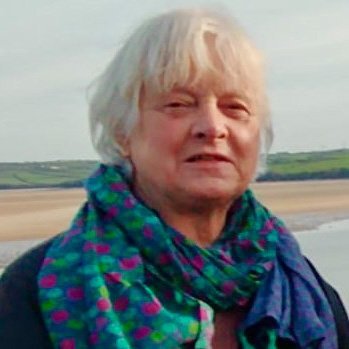
JACQUELINE JARVIS
I qualified as a State Registered Nurse in 1968 before completing a Fine Arts Degree at Falmouth College of Art in 1996, followed by postgraduate studies at Exeter University. Since 1979, I have lived with my family in the coastal hamlet of Trevalga, where the landscape continues to inspire my work as both a painter and printmaker.
My art is rooted in a lifelong fascination with the natural world and the passage of time—whether captured through figures in motion or the ever-changing landscape. Literature, poetry, philosophy, and art history have all deeply influenced my practice.
I am the author of two books: Time That Moves in Circles, Time Counted in Straight Lines (2016), exploring how we perceive and measure time, and Large Piece of Paper, Small Brush, a retrospective tracing the evolution of my work from student days to the present.
During my time as Artist in Residence at Terre Verte Gallery for Marking Time, I reflected on key moments of development in my practice—from early explorations of technique to the influence of artists such as Vija Celmins, whose conceptual approach encouraged me to look deeply and think critically. Encounters with original artworks in galleries and museums were equally formative, helping to shape my direction and clarify what I wanted to express.
Over the years, my work has evolved through both chance and curiosity—whether sketching cyclists at the Manchester Velodrome or interpreting photographic imagery through etching. During the latter part of my life I have been freer to follow my own path, creating work that connects to the community and landscape I love.
Living and working in North Cornwall has placed me within a rich artistic tradition of independent, often ground-breaking artists who draw inspiration from the same elemental coast and landscape. I feel fortunate to contribute, in my own way, to this ongoing dialogue between place and artistic expression, and remain deeply grateful to the local galleries and supporters who have encouraged me throughout my journey.
Poetic Names of Moons
Cyclists
When I was asked to write a text as ‘Artist in Residence’ for an exhibition at Terre Verte Gallery entitled, ‘Marking Time’, I thought it would be interesting to talk about the pivotal stages of my artist development. My interest in figures in motion and their association to time began as a art student at Falmouth during the 1990’s. I also became interested in dry point etching as an adjunct to painting. This proved to be immensely useful after I graduated as it provided the opportunity to sell print editions at affordable prices and thereby introducing my work to galleries both in the local area and further afield. To this end I joined the National Print Council based in London.
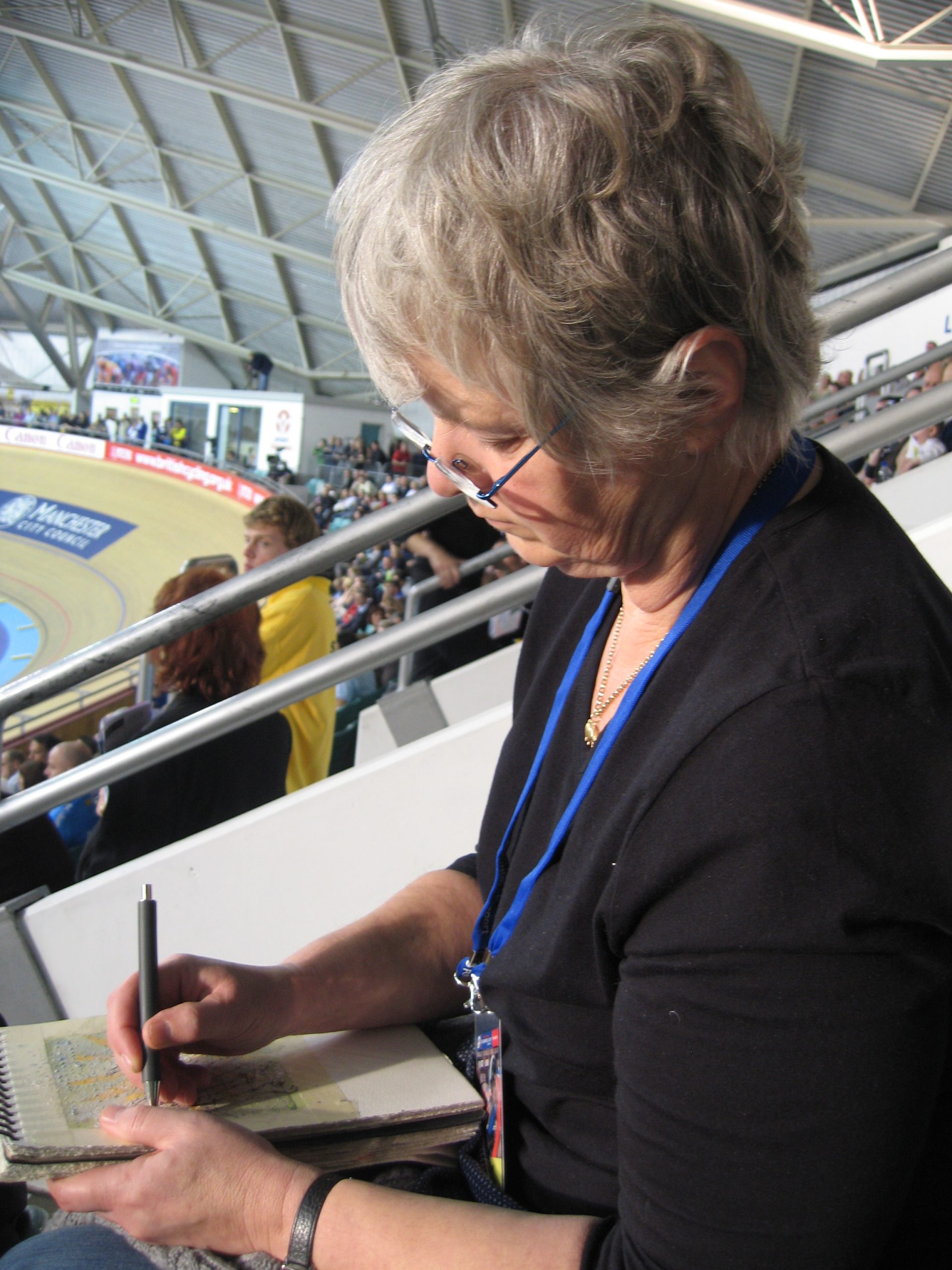 Serendipity plays a part in many areas of life and my focus on this subject was assisted because my husband, Dr. Chris Jarvis, has had a long association with elite cycling as a sports physician. On several occasions I accompanied him to events at the Manchester Velodrome and elsewhere, where I was given accreditation to view competitions. This often provided an advantageous viewpoint, and it would have been remiss of me not to record the experience in my sketchbooks. The body of work I produced at the velodrome proved pivotal to my artistic development.
Cycling was growing rapidly in popularity at the time, supported by new facilities and a system designed to nurture young talent. Many of these athletes would later become household names, including, Sir Chris Hoy, Chris Boardman, Sir Bradley Wiggins and Sir Mark Cavendish.
On one occasion I acquired a photo – finish image of a cyclist crossing the line at the end of a race. ( photo Finish Scan of Italian Cyclist 1996 ) Unlike film-based images or photographs, scans of the finish line are not a frozen moment in time, like a conventional photograph. They lie somewhere between a photo and a video. The scanning camera equipment continuously takes a very narrow image, approximately one pixel wide. These slices are then placed side by side and blended together to in the final image. I enlarged and transposed this image onto three large aluminium printing plates using dry point etching. I worked vertically top to bottom and from left to right across the surface of the plates to emulate the original image. I was not aiming to produce a photo realistic image, rather an interpretation of the original. The results introduced a temporal element into the surface of the work that was very interesting. ( In Pursuit of a Line number 1 1997 )
In Pursuit of a Line Number 2
During 2012 I was invited to exhibit related work at local museums and art galleries in Cornwall in celebration of the Olympic and Paralympic Games in London. These invitations inspired me to create another version of the 1997 image In Pursuit of the Line. In January 2012 I acquired a photo-finish image of Wendy Houvenaghel, who was then a member of the GB women’s team.
I started to work with soluble graphite on thick paper, using three separate sheets in the spirit of the original print. My working methods had naturally developed from the previous transcription thirteen years earlier. I worked a vertical strip each day from left to right across the picture plane, effectively creating a daily diary. Each separate sheet of paper represents a calendar month: the first was started on 1 February, the middle on 1 March, and the third on 1 April.
As this work was destined for local exhibitions, and Wendy lived in Cornwall, I thought it appropriate to include the daily headline from Radio Cornwall’s website. The addition of the text was interesting — it located the image at a specific point in time, and although the Olympic Games had international significance, local news reflected issues much closer to home. The ‘pasty wars’ were a prime example, when the then Conservative Government attempted to introduce a 20% tax on this popular Cornish version of fast food, which inevitably became contentious.
(For larger view click image)
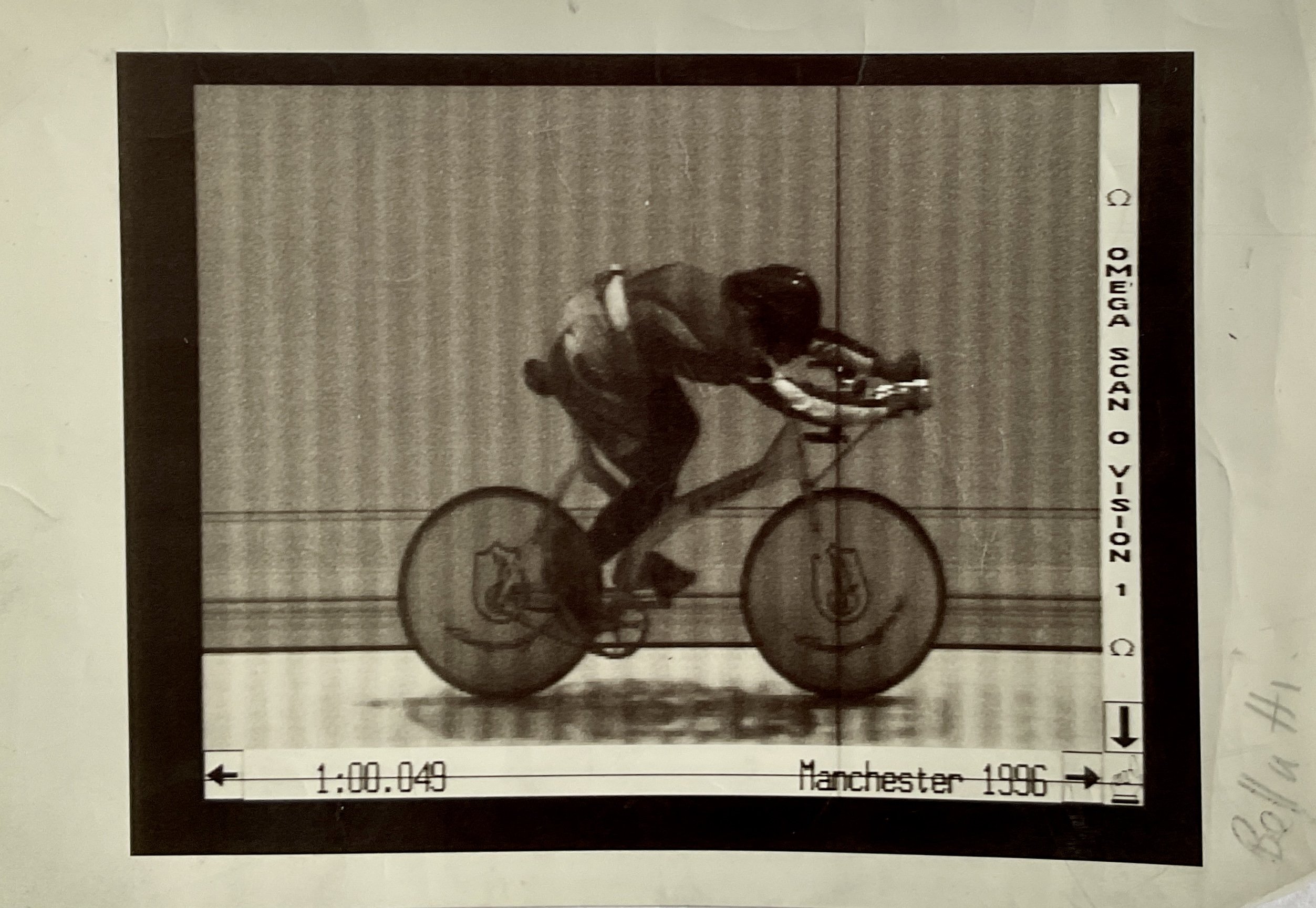
Photo Finish Scan of Italian Cyclist. 1996
Size 9.5 x 13 CMS
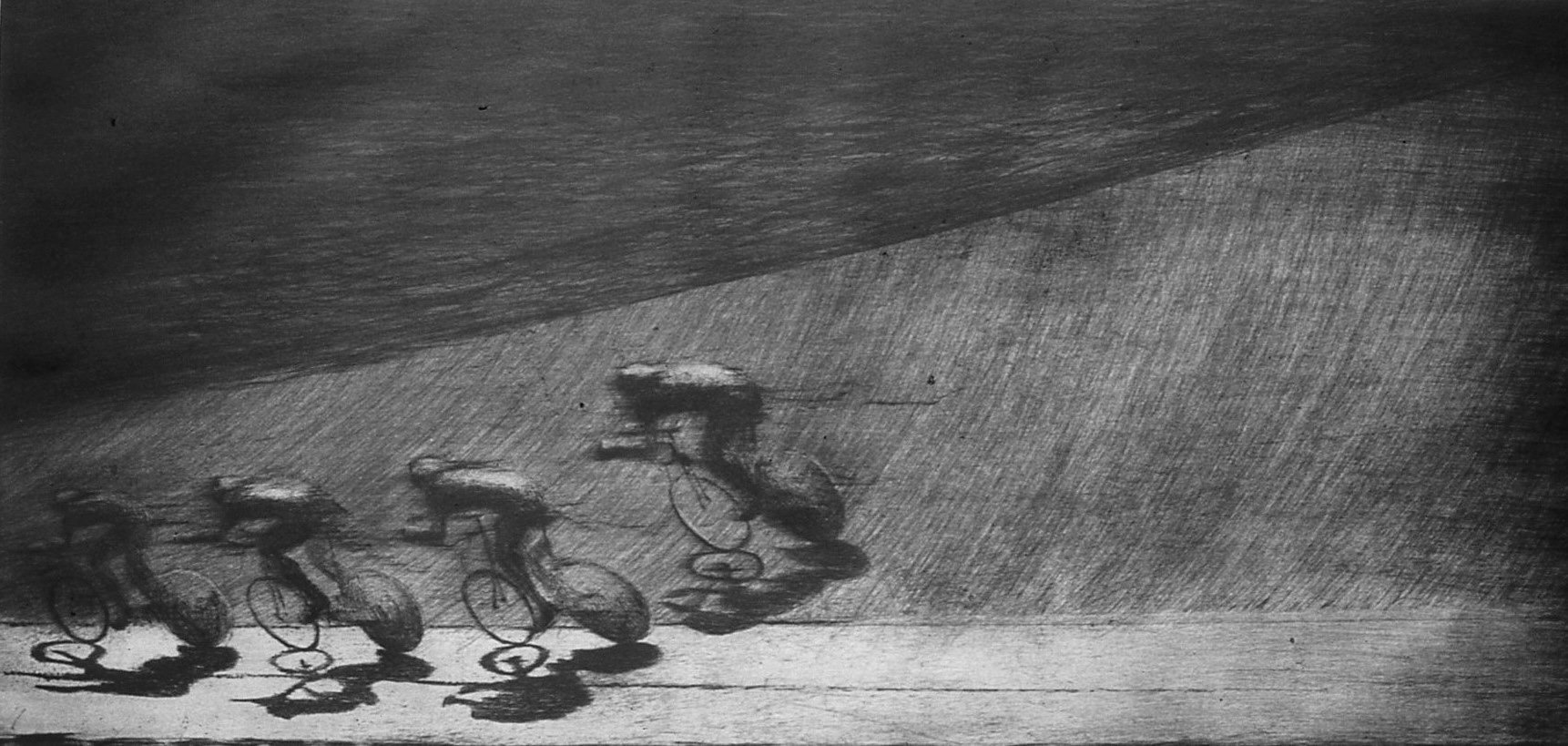
Pursuit number 3. 1997
Dry Point Etching size 30 x 60 CMS
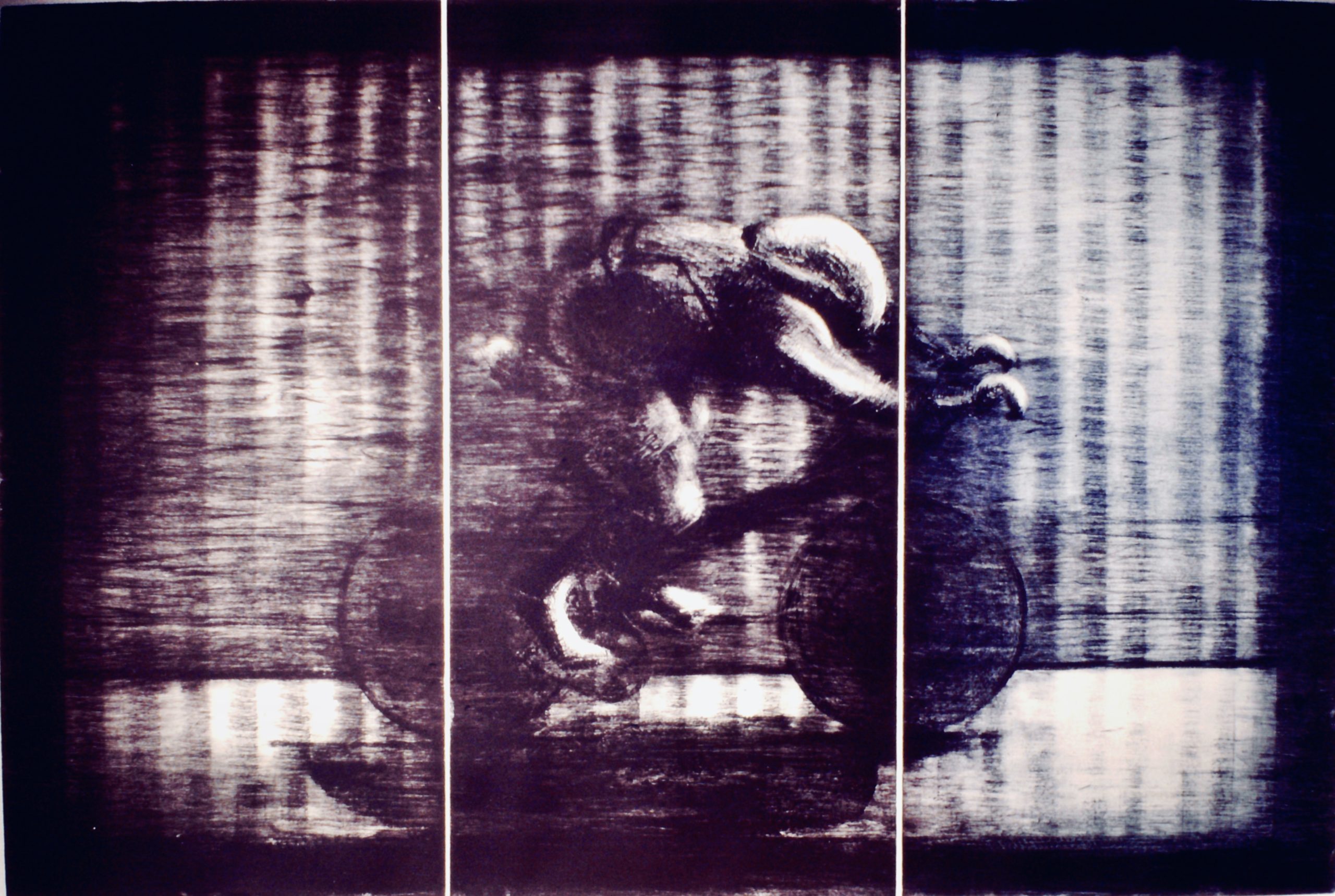
In Pursuit of a Line Number 1. 1997
Dry point etching 60 – 90 CMS.
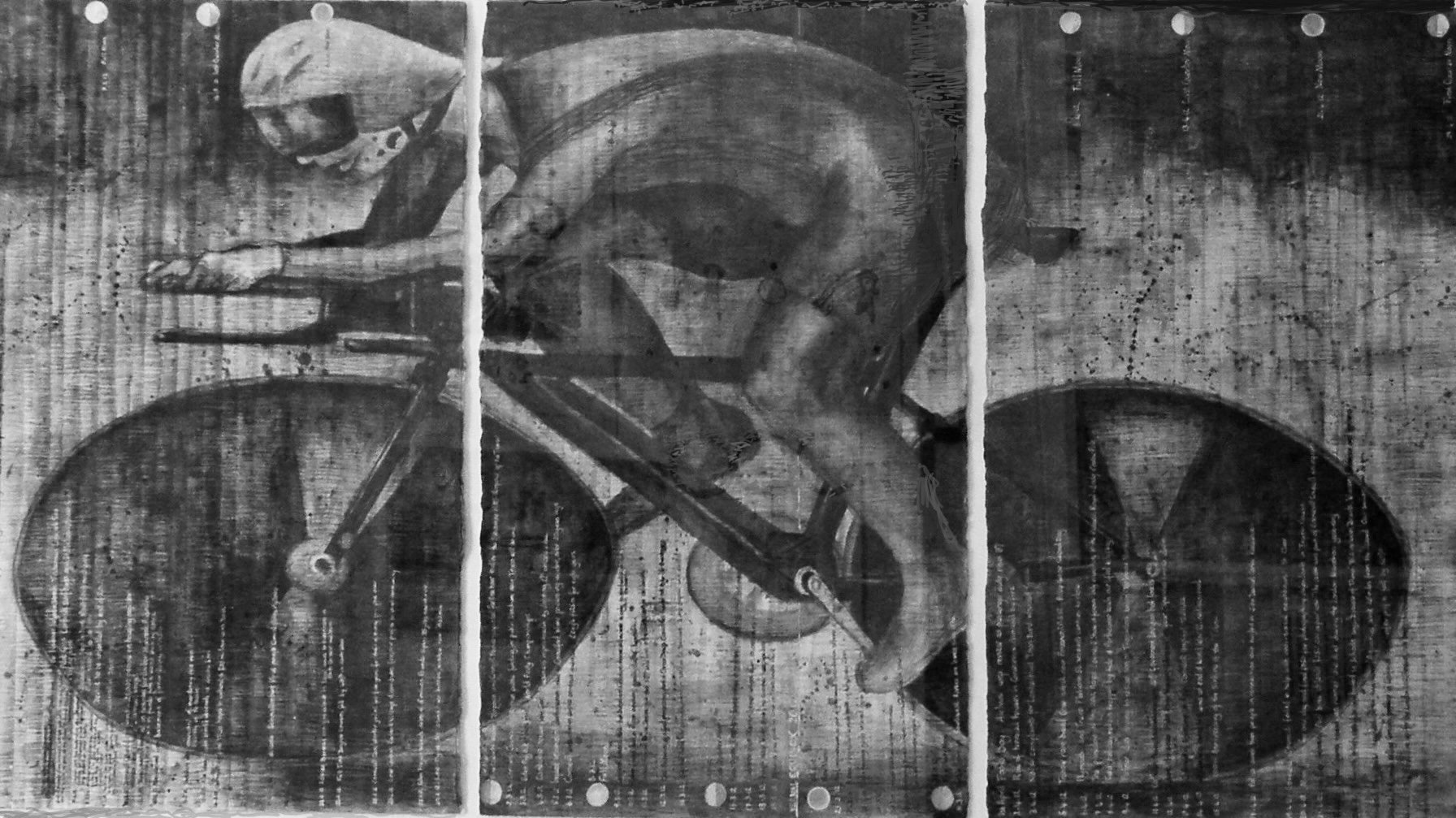
In Pursuit of a Line Number 2. 2012
Soluble graphite on paper. Size 75 x 140 cm. 2012
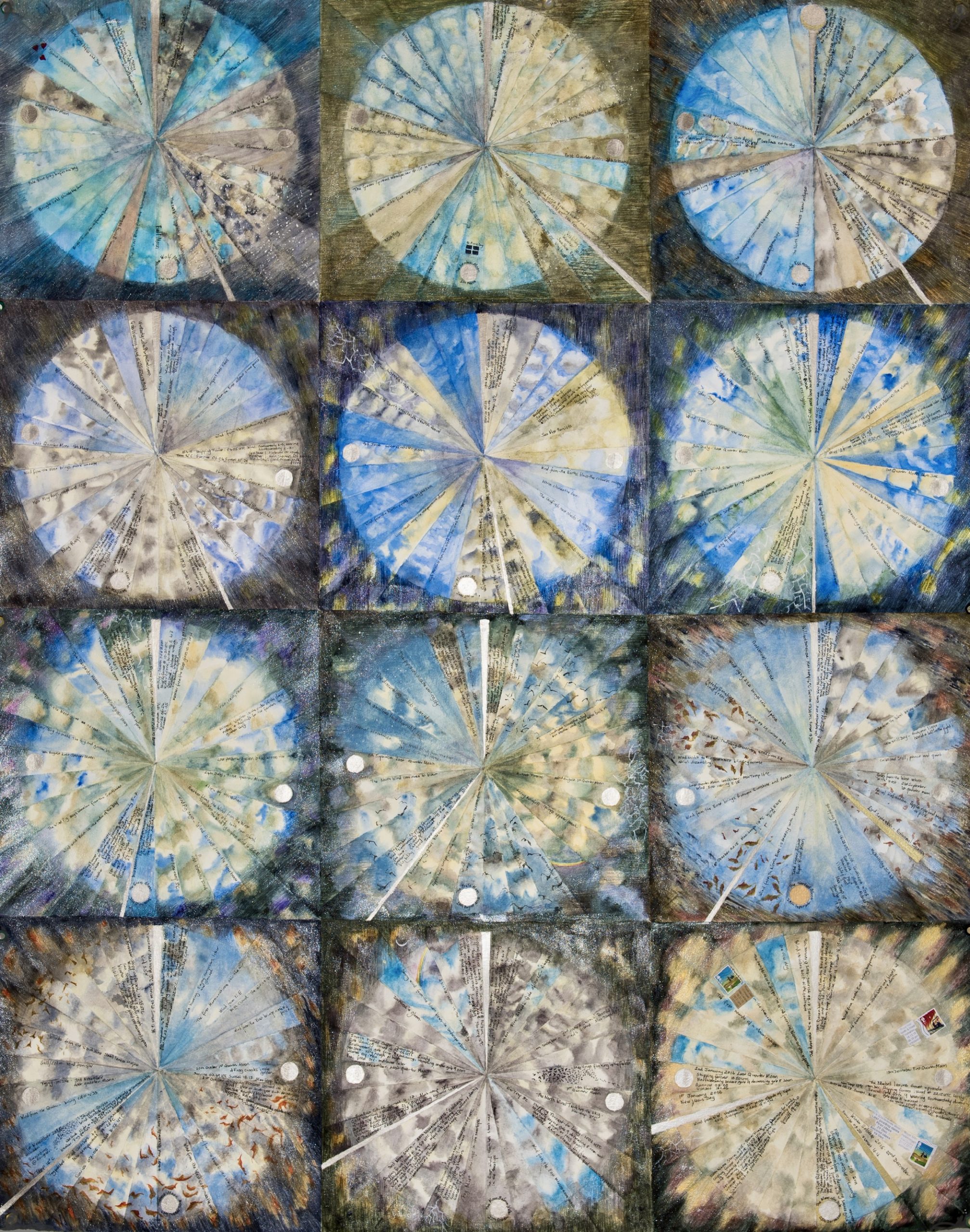
Circular Chronicle 2008
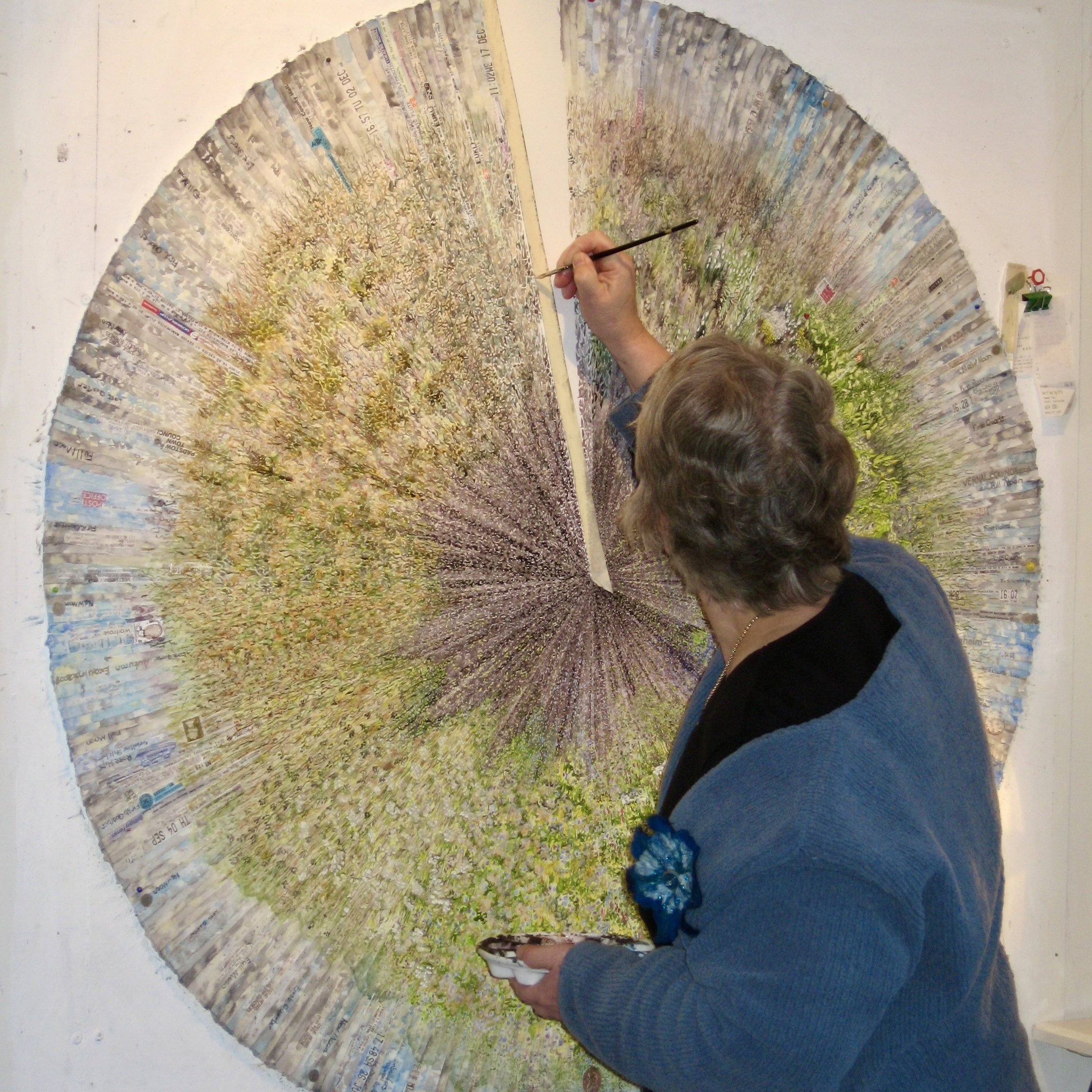
Unlike music or literature, painting does not command a time of viewing as opposed to listening or reading. One traditional way of overcoming this problem in the visual arts is to incorporate illusionary perspectival techniques to suggest a visual narrative as in the image of Pursuit Number 3. These techniques function as a visual narrative for time and movement. However, the activity of painting has its own temporal element related to the time and place of their inscription. Calendars provide a very convenient framework within which this idea can be made visible in they display the past, present and future on a two dimensional plane. Calendars are a social construct unrelated to lived experience of duration, or connections made from moment to moment. The circular chronicles aspire to explore these connections. There were three paintings in the series, 2007, 2008, 2009.
The diameter of the circle had to be large enough to allow space to express information around its outer edge. The largest watercolour paper I could find measured 122 x 152 cm. A circle of 122 cm in diameter was scribed onto the surface and then torn to produce a deckle edge. The circle was marked out into twelve sections, like a clock face, each representing a month of the year. This made it easier to subdivide into calendar days.
Each painting was commenced at twelve o’clock on 1 January, and subsequent days followed in a clockwise direction. Each day was masked off and started from the centre, working towards the outer edge. The central area was too narrow to record any information, so this was resolved by using soluble metal powders such as gold, silver, and palladium, dotted between areas of watercolour. In some curious way—though not intentionally—this located my physical presence within the work.
The paintings record the colours of the landscape seen looking northwest through my studio window. They also record seasonal events such as the flowering times of wildflowers, the return of the swallows in springtime, and the daily weather. The phases of the lunar cycles are noted, as are the solstices and equinoxes, the latter expressed in gold. The use of ephemera continued, as in previous paintings. My aim was for these three paintings to have as much visual impact when viewed from a distance as they did upon closer inspection.
(For larger view click image)
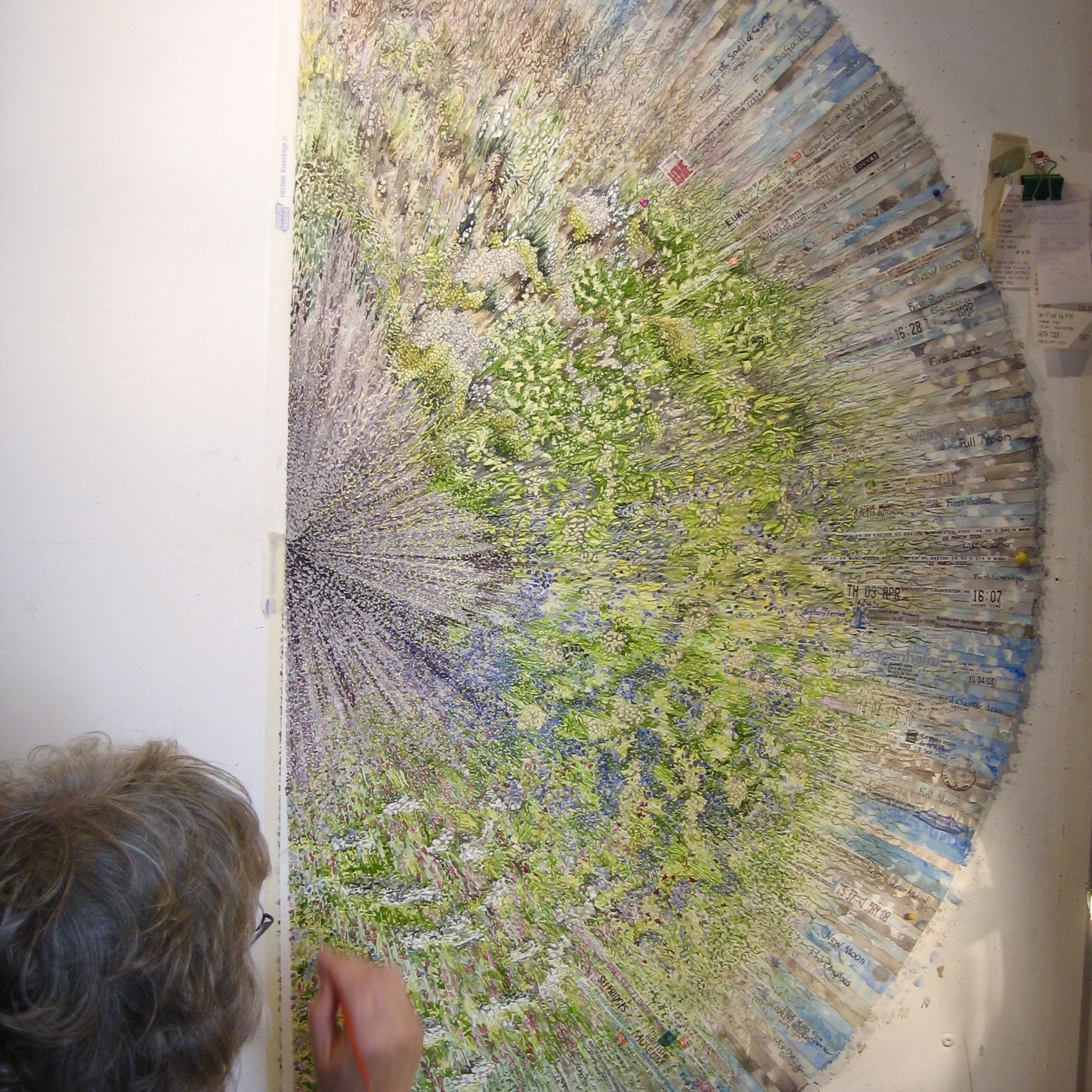
Circular Chronicle 2008 in progress
Circular Chronicle 2008 being completed.
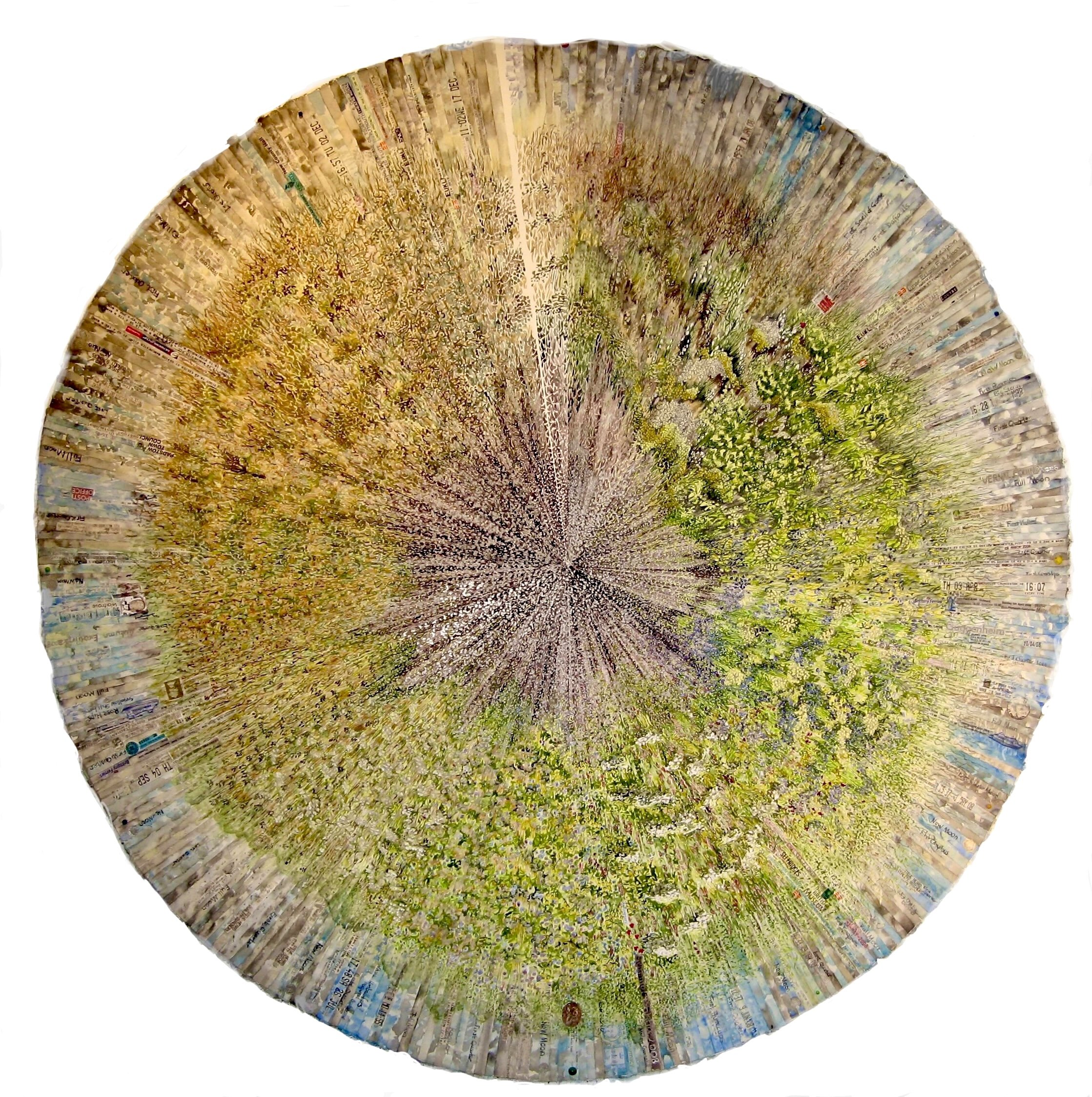
Circular Chronicle 2008 complete
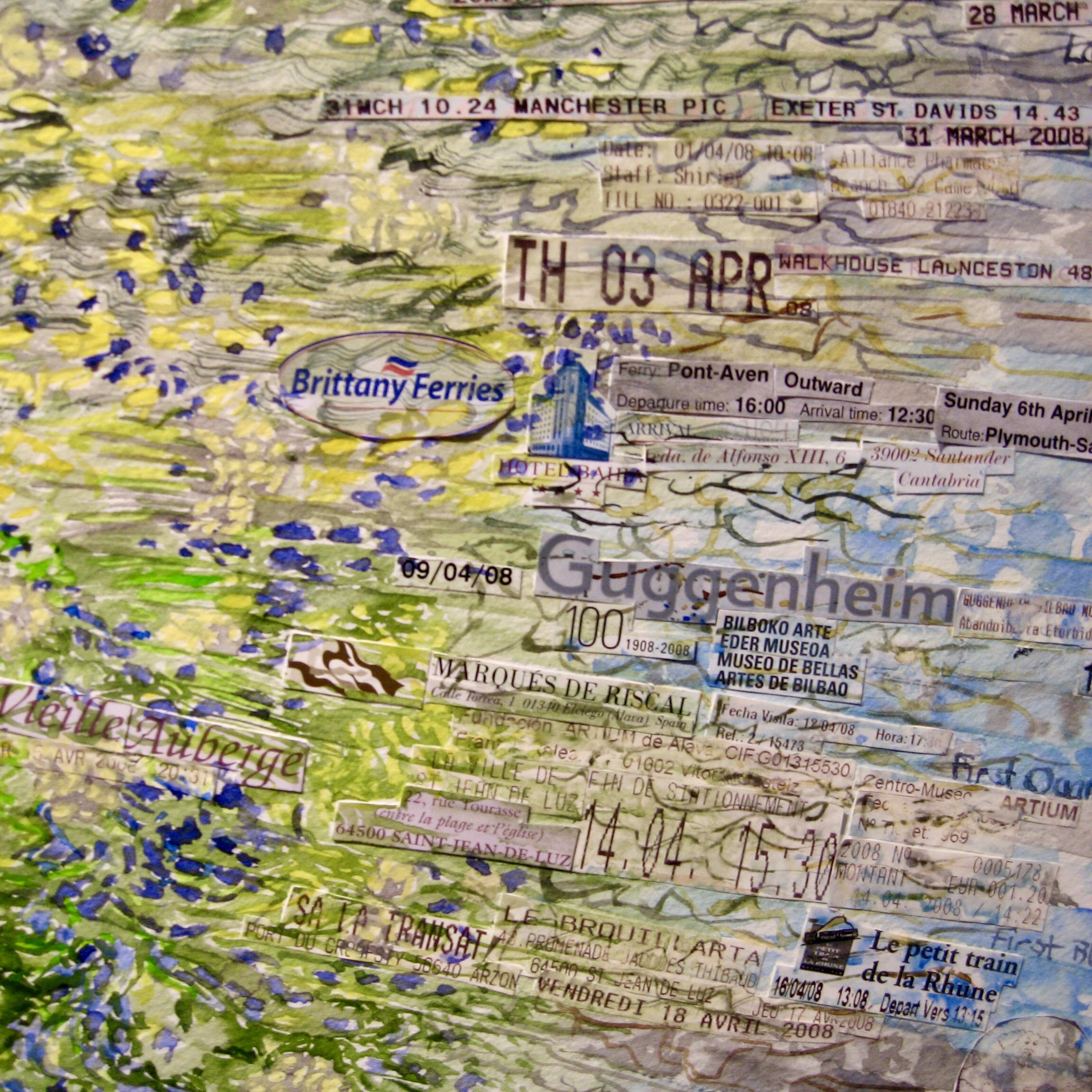
Detail from 2008 Circular Chronicle
Chronicle of a Hawthorn
I chose an easily accessible hawthorn tree that grew close to the house and displayed the windswept characteristics typical of trees in the exposed southwest. The tree was photographed between 1200 and 1300 hours from the same location at the start of each month, and the images were enlarged to A3 size by photocopier, then divided into twenty-nine vertical strips.
The black-and-white photocopy assisted the daily transcription of shape, enabling me to retain the proportions of the form. I worked a strip each day from left to right, as with the photo-finish image in 1997. Collaged ephemera such as tickets and postage stamps were added to mark the registration of calendar days. Location and orientation were also noted in the form of a postal code, compass bearing, local weather, and the shipping forecast for Lundy.
(For larger view click image)
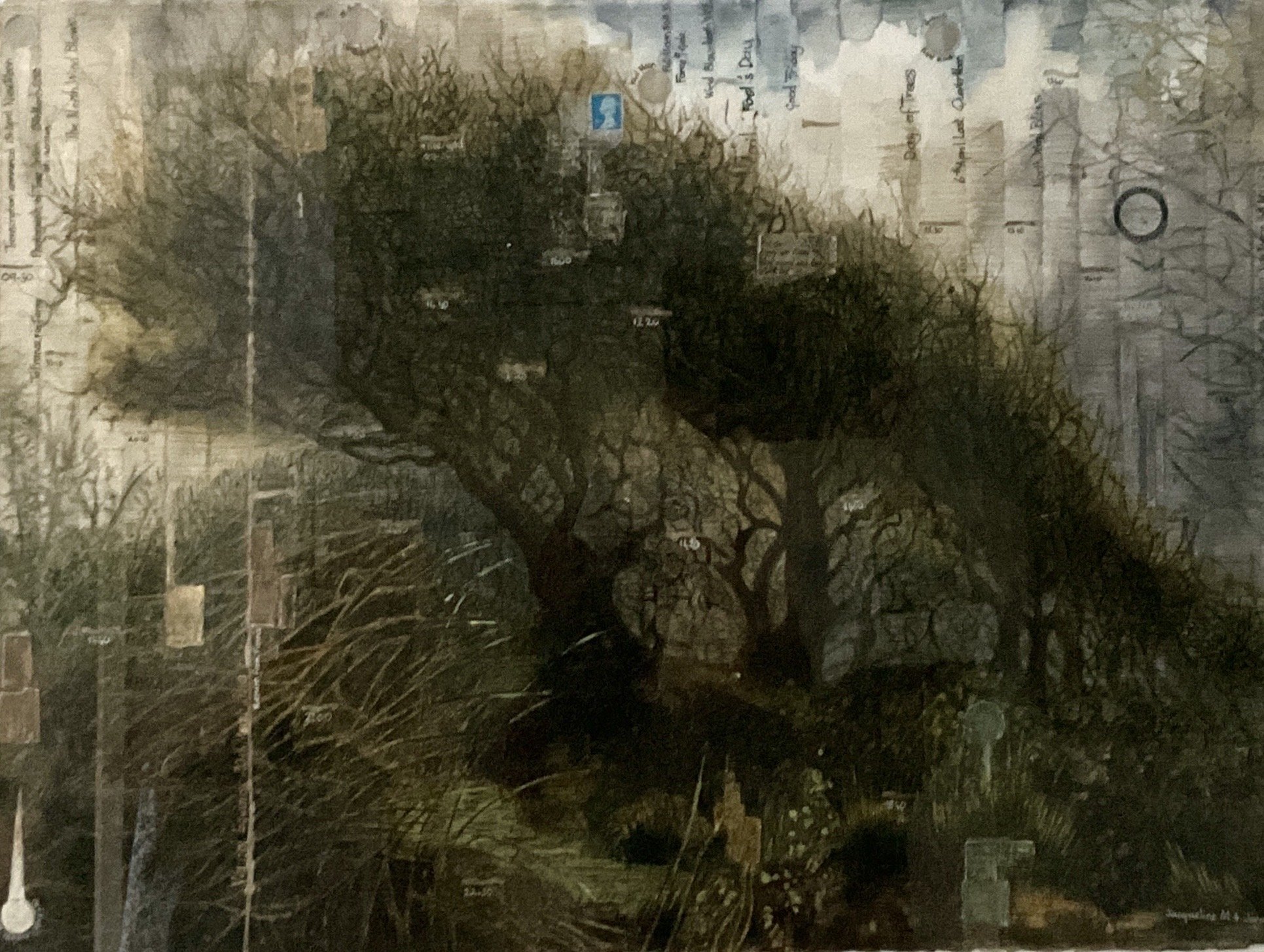
Spring Chronicle 2010
Size 56 x 76cms
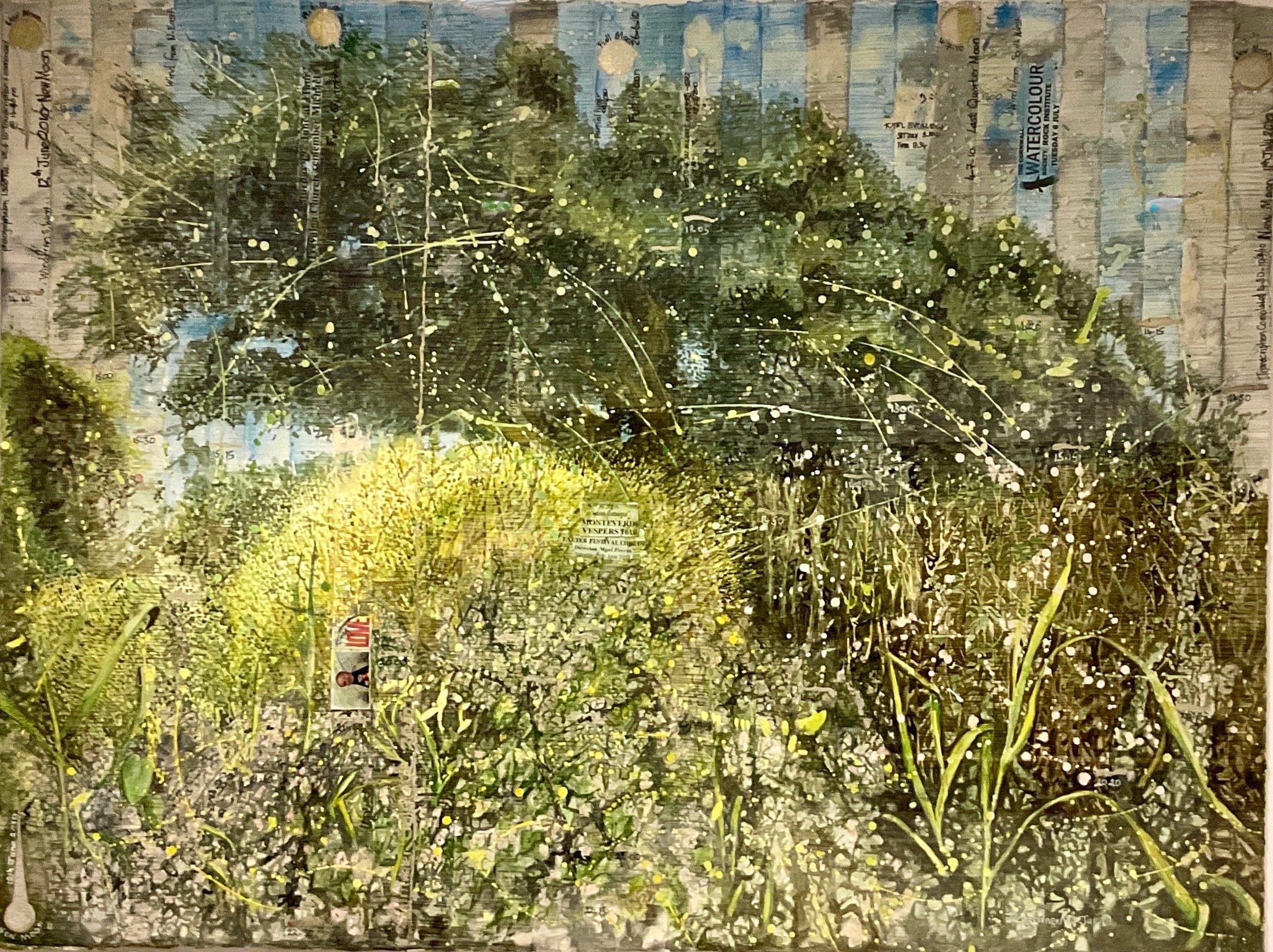
Summer Chronicle 2010
Size 56 x 76cms
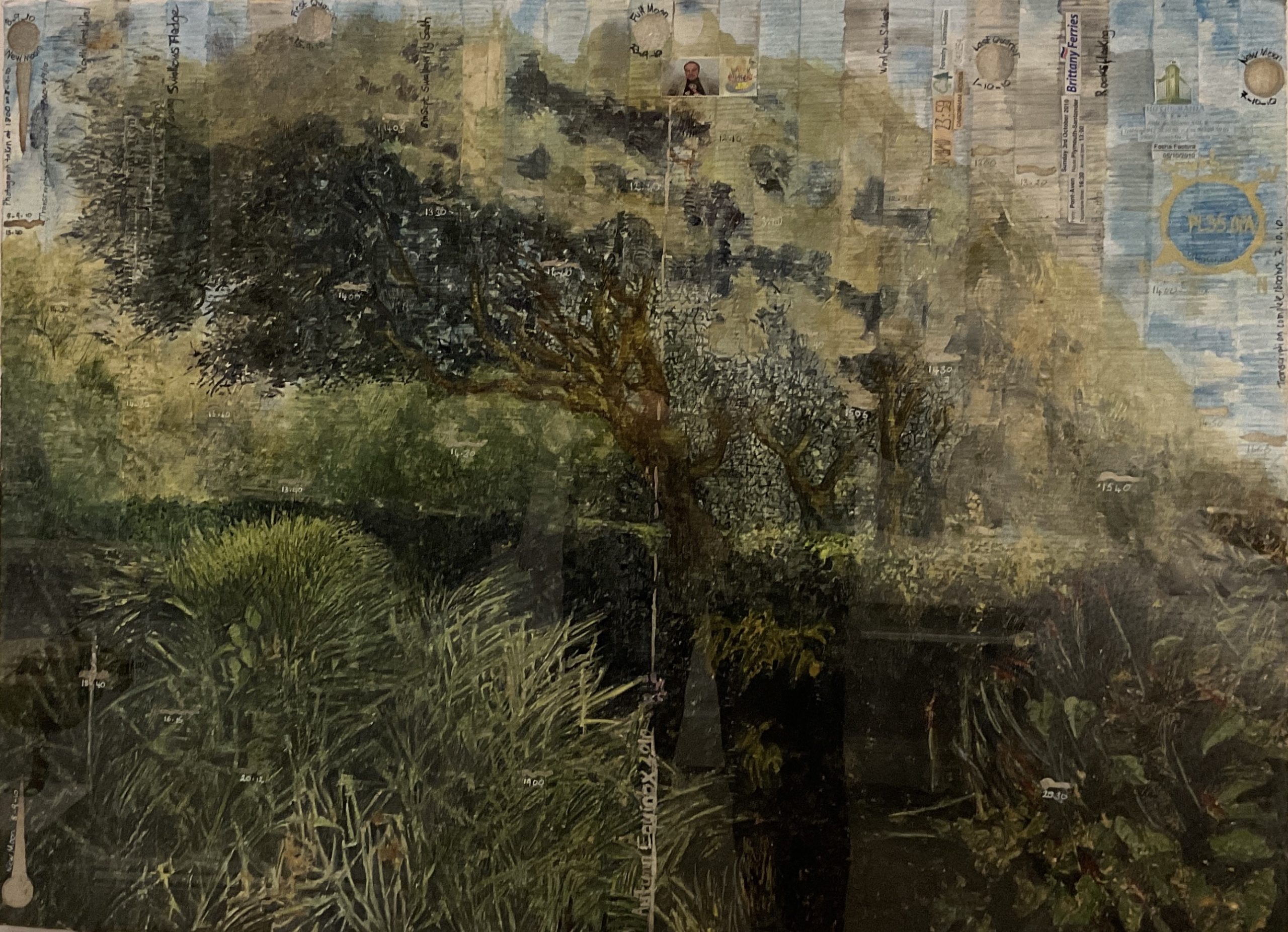
Autumn Chronicle 2010
Size 56 x 76cms
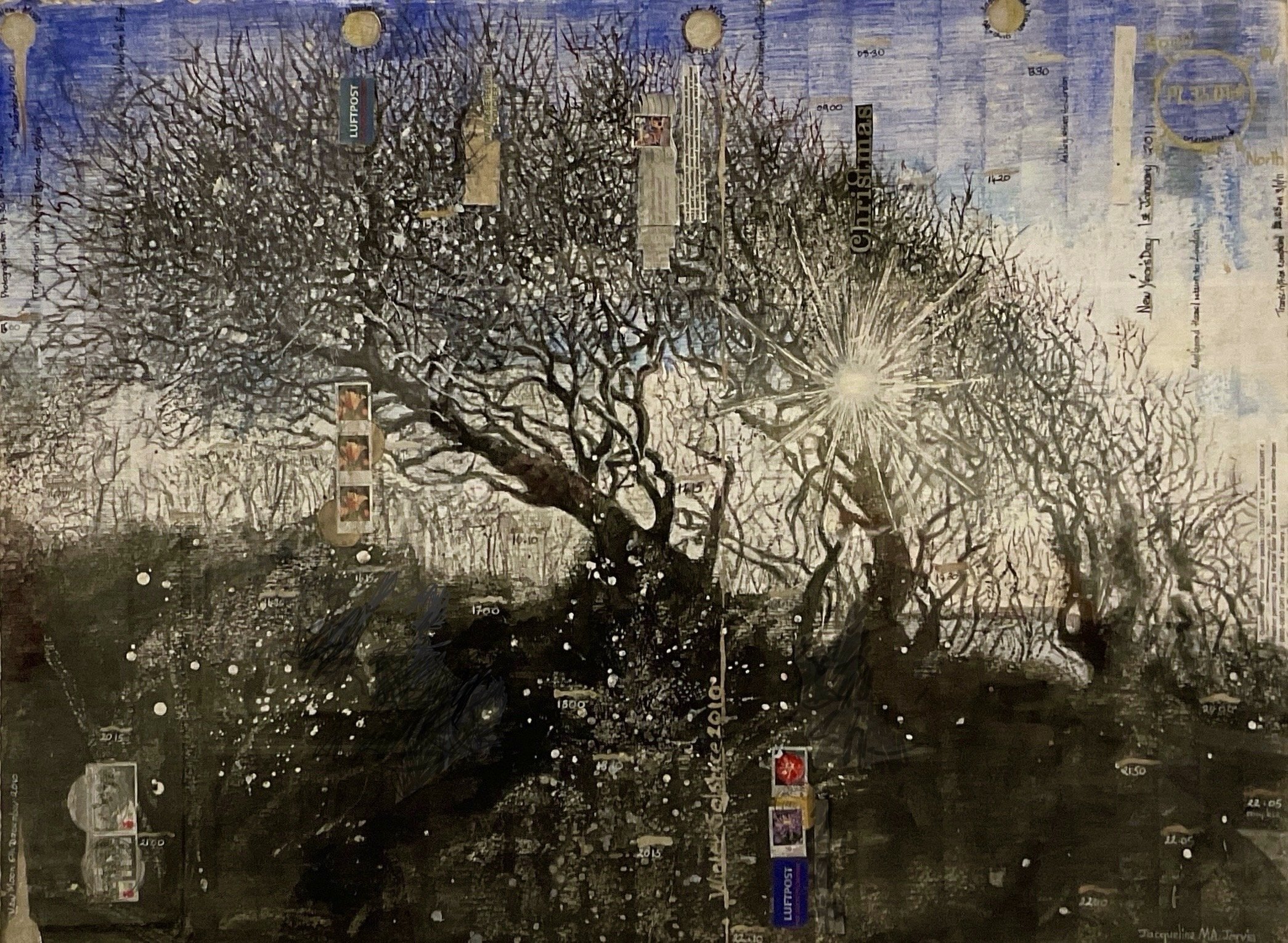
Winter Chronicle 2010
Size 56 x 76cms
Spiral Chronicles
Spiral chronicle 2018. We moved house which precipitated a change in direction
In my old studio, I started to construct another annual chronicle of the days of the year. I had been contemplating using a spiral composition for some time. This was a tangential step from the linear expression of recording data, towards a freer methodology. The disruption of the move seemed like an ideal opportunity to try something challenging. The spiral painting was started, on 1st January 2018. Each day unfolded like a small splurge of light in a dark sky. Gradually, notations on the events of the year started to appear, for example, the first frogs spawn in the pond, the first snowdrops.
The Spiral Chronicle Lockdown Project, 2020–2021
Many artists responded to the lockdown restrictions by engaging in a project. With little time to plan, I decided to revisit the methodology of the earlier spiral chronicle. On the Spring Equinox, 20 March 2020, I began a new chronicle, overlapping with the first national lockdown three days later.
The spiral concludes on 12 April 2021, at the end of a lunar cycle and coinciding with the easing of some lockdown restrictions. Throughout the project, I recorded the daily numbers of confirmed Covid cases and deaths, using data from the Office for National Statistics (ONS). These figures were transcribed each day into a space below the painting. The recording of deaths and confirmed cases continued until 1 August 2021, when the final restrictions were lifted.
(For larger view click image)
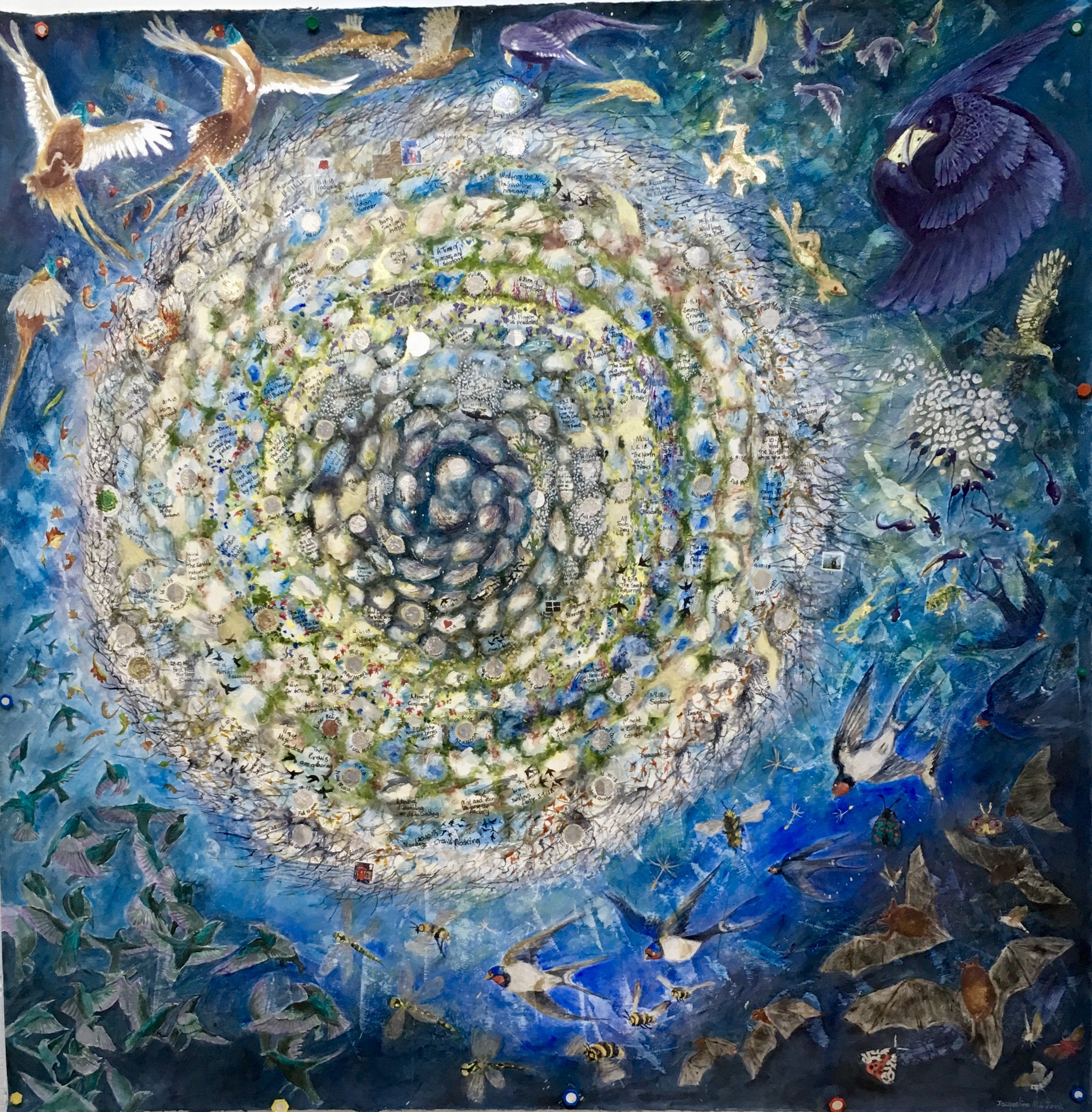
Spiral Chronicle 2018-19
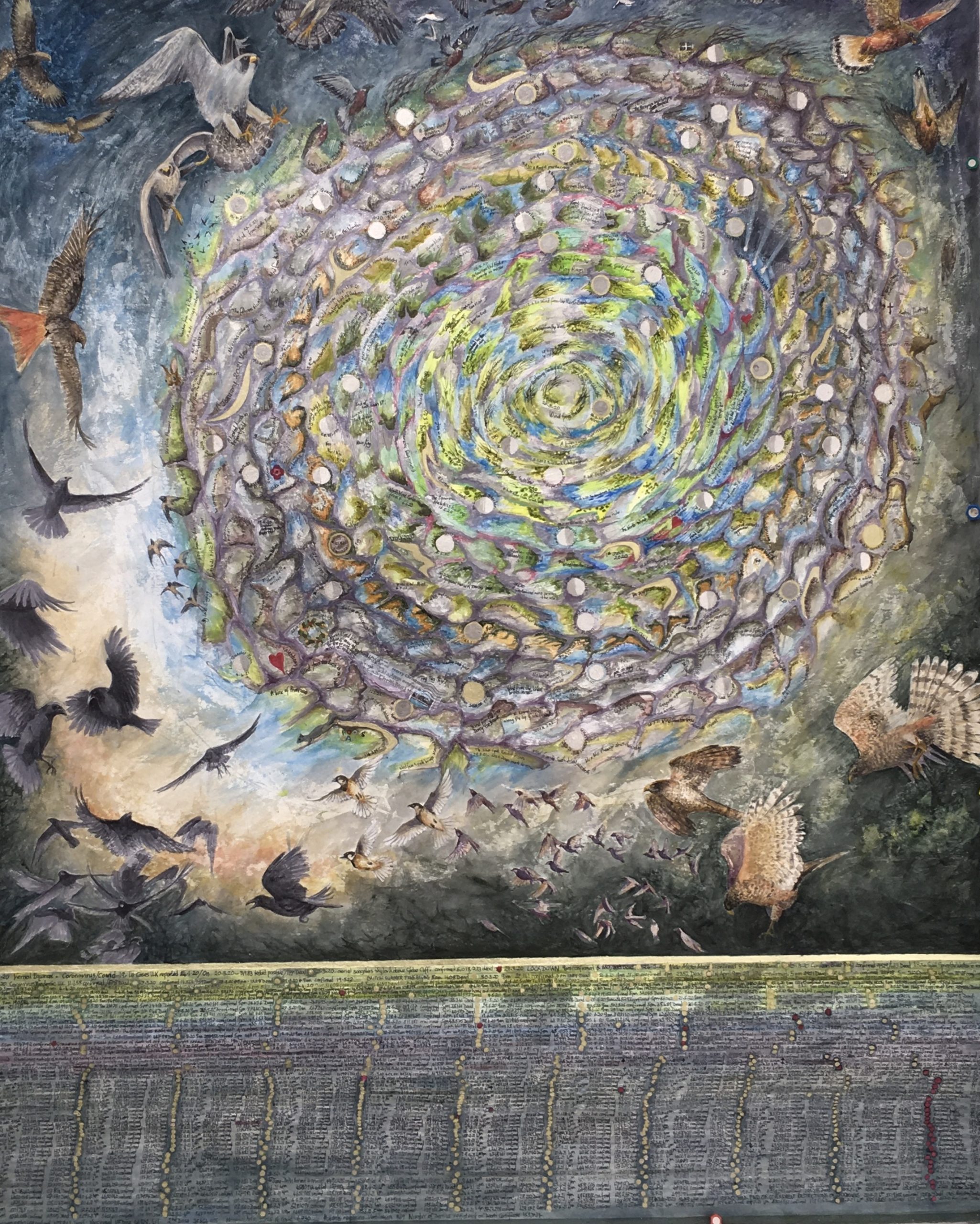
Spiral Chronicle 2020-21 Covid Lockdown Project
Conclusions
To conclude, my paintings and printmaking explore incremental changes over a duration of time. These works may use the social constructs of clock time and calendars as a starting point but at a deeper level they are a celebration of living in the present and attempt to place my physical self within a time frame. The paintings ask what is meant by location, is it just a grid reference or a post code or the social construct of calendar dates? The more I have painted the less certain I have become and hence the move recently to the relative chaos of spiral compositions. At the simplest level these paintings attempt to express small connections over the duration of time.
Books
More details of Jacqueline’s work and practice can be found in her excellent books, both of which can be obtained by emailing us at terreverteinfo@gmail.com or from her own website www.jacquelinejarvis.co.uk ‘Time That Moves in Circles’ is £18.00 +pp; Large Piece of Paper, Small Brush is £20.00 +pp.”
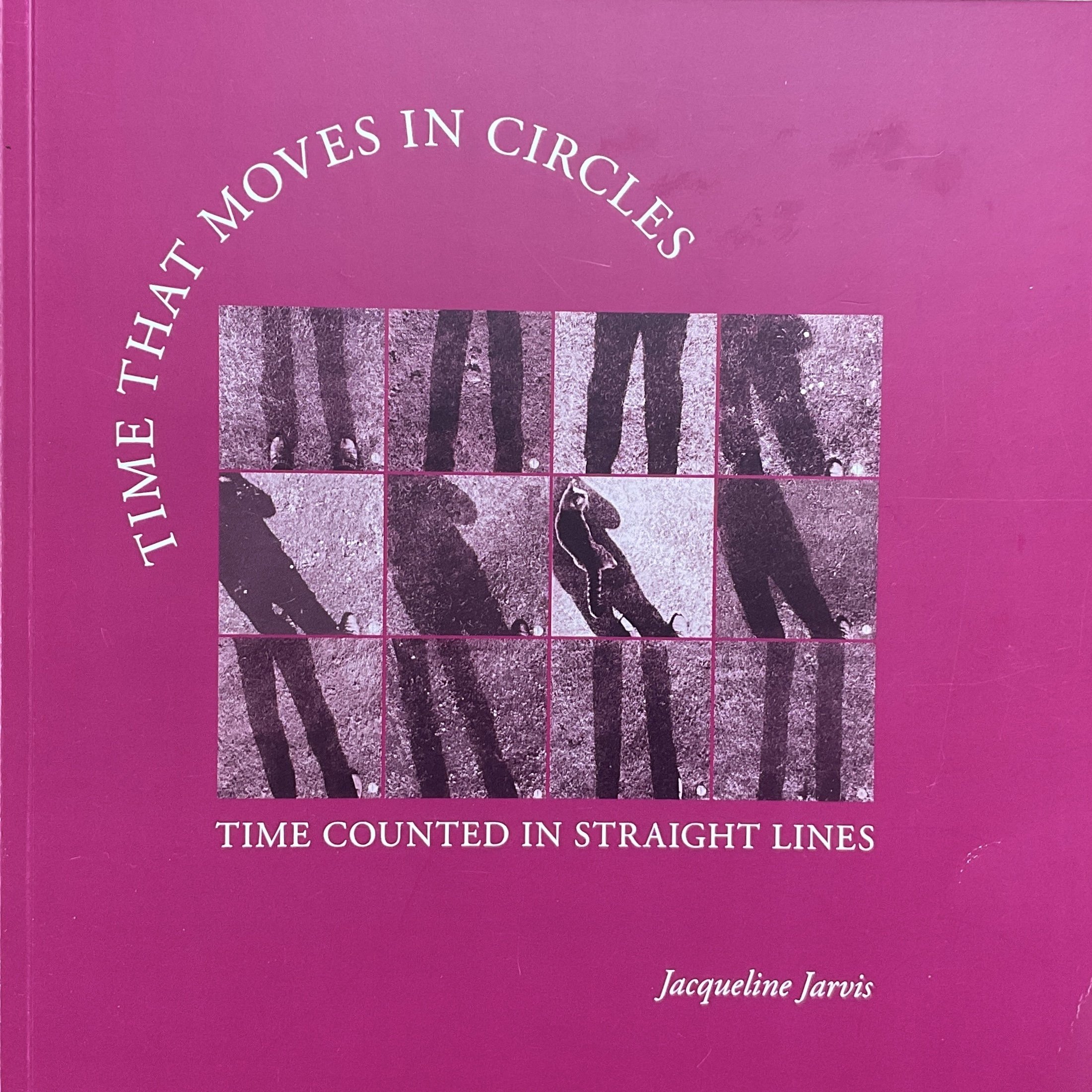
Time that Moves in Circles, Counted in Straight Lines
This book explores the schism between cyclical time as in the seasons of the year and the social construct of calendar or clock time. There are very limited copies of this first book available. It was a limited edition of 150 signed copies, privately published in 2013. Price £18 plus pp.. (Postage quoted for uk only, price on asking)
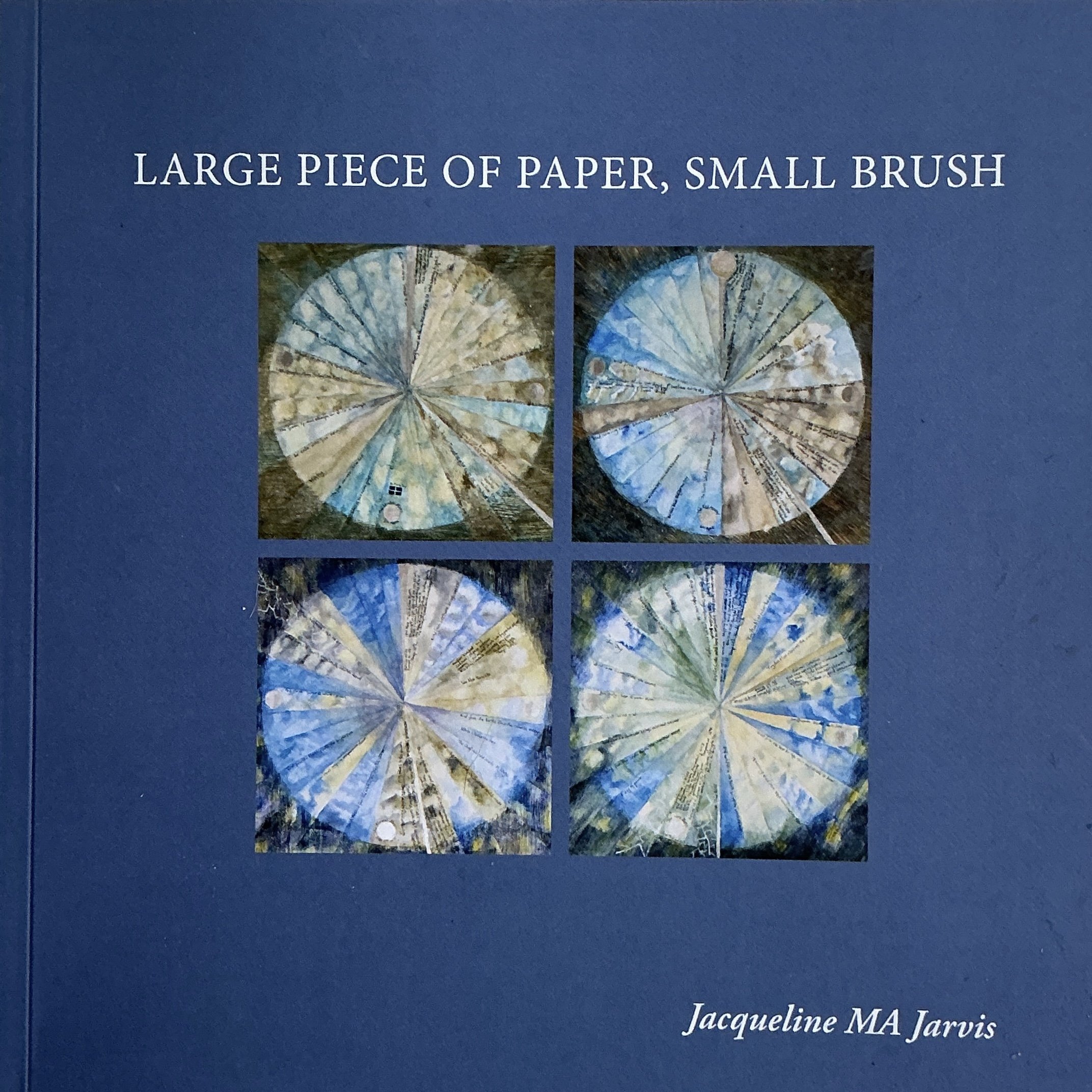
Large piece of Paper, Small Brush
Limited edition of 150 signed copies. Private publication, completed in 2025. Price £20 plus pp. (Postage quoted for uk only, price on asking)